
Meccano Compatibility Explained: What Actually Fits and What Doesn’t
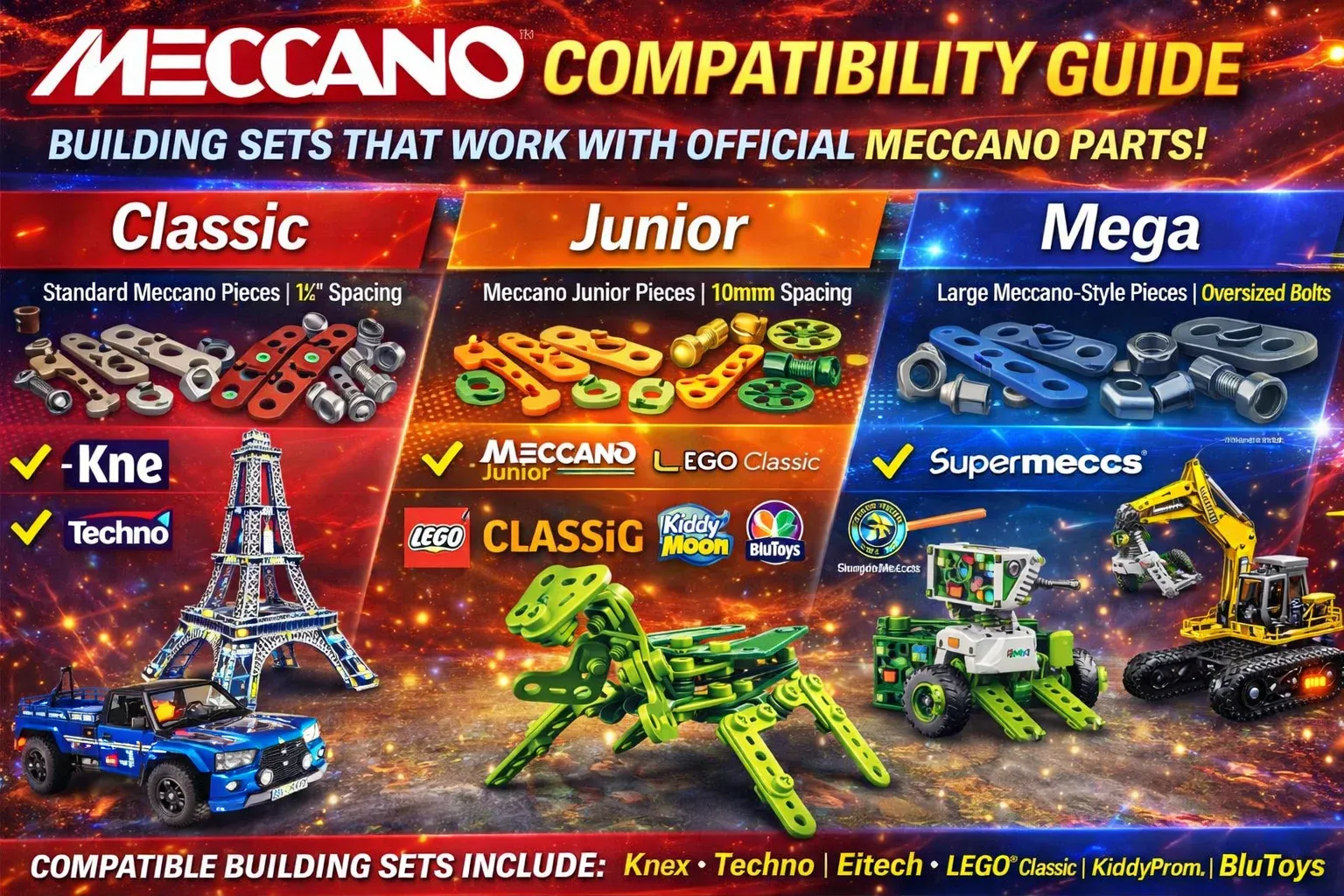
Meccano Compatibility Guide
Almost every Meccano builder reaches the same moment sooner or later. The table is covered in parts from different boxes, sometimes from different years, and one simple question appears.
Will these parts actually work together?
This guide explains how Meccano compatibility really works, what mixes well, what does not, and how to build with confidence instead of guesswork. If you are also trying to decide which set to buy next, see the best Meccano sets guide for a full ranked list.
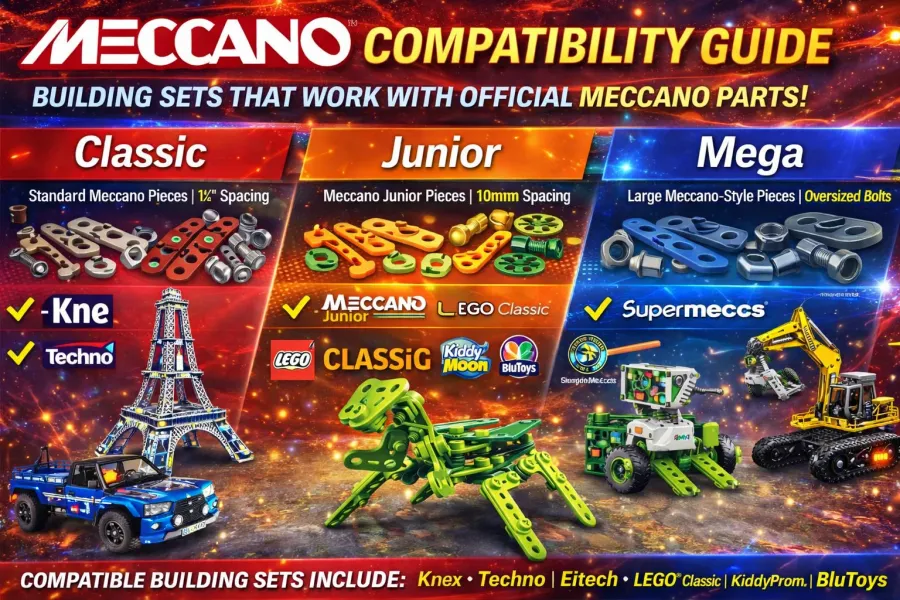
Why Compatibility Matters More Than Most Builders Expect
When people talk about compatibility, they often mean one simple thing: whether two parts can physically connect. In Meccano, that question is only the beginning.
True compatibility includes strength, alignment, weight distribution, material behavior, and how forces travel through a structure once motion is introduced. A beam can bolt on perfectly and still create problems later. A gear can mesh smoothly and still introduce friction a motor cannot overcome.
Builders who understand compatibility early approach Meccano differently. Instead of forcing ideas to work, they design with the system in mind. The result is fewer rebuilds, stronger models, and a building experience that feels rewarding instead of frustrating. For more on how to fix common compatibility-related problems, see the Meccano troubleshooting guide.
What Compatibility Really Means in the Meccano World
In the Meccano world, compatibility is not a yes-or-no question. It is a relationship between parts, materials, and forces. Two components might connect perfectly on the table and still fail once movement, weight, or vibration enters the picture.
This is because Meccano is closer to real engineering than many construction toys. Bolted connections transfer load. Axles experience torsion. Gears amplify resistance. When compatibility is right, these forces balance naturally. When it is wrong, problems appear quickly and repeatedly.
Experienced builders often describe compatibility as something you can feel. A compatible build feels calm and predictable. Adjustments improve behavior instead of introducing new issues. An incompatible build constantly fights back, even when it looks correct.
Once you adopt this mindset, Meccano becomes far more enjoyable. You stop chasing fixes and start designing with intention. That shift dramatically improves build quality and long-term satisfaction. For a comparison of how Meccano and Erector parts interact across product generations, see the Erector vs Meccano guide.
Looking for the best Meccano set to expand your collection with compatible parts?
★ Best Meccano Sets GuideClassic Metal Meccano: Why It Remains the Gold Standard
Classic metal Meccano has survived for generations because its core logic works. Hole spacing, bolt sizes, and structural geometry have remained remarkably consistent. This consistency allows builders to combine parts from different eras without worrying about unexpected incompatibilities.
Metal also behaves honestly. When a structure flexes, you can see it. When a bolt loosens, you feel it. Nothing is hidden behind snap-fit tolerances or flexible connectors. This transparency makes problem-solving intuitive instead of frustrating.
For builders who plan to expand gradually, metal Meccano offers unmatched long-term compatibility. A collection grows organically instead of becoming outdated. Parts purchased today will still matter years from now. For replacement parts when components wear out, see the Meccano replacement parts guide.
Jerrel's Builder Insight
One of the most common mistakes I see is builders blaming themselves when a model does not behave as expected. In many cases, the issue is not skill - it is compatibility.
When parts naturally work together, a build almost guides you. When compatibility is forced, every step feels like a struggle. Learning to recognize that difference is one of the most valuable Meccano skills you can develop.
For a deeper look at how Meccano compares to Lego Technic in terms of mechanical behavior and compatibility with real-world engineering principles, see the Meccano vs Lego Technic comparison.
Modern Plastic Meccano: Faster Builds, Different Rules
Modern Meccano introduced plastic components to lower the barrier to entry. Snap-fit frames and molded connectors make early success faster, especially for younger builders or casual projects.
Within the modern plastic ecosystem, compatibility is strong. Sets are designed to work together visually and mechanically. Problems usually appear when plastic parts are mixed with classic metal without considering their different material behavior.
Plastic flexes. That flexibility absorbs vibration but also stores tension. Under load, plastic structures can slowly shift, changing alignment and increasing friction. This is not a flaw - it is simply a characteristic of the material. Builders who respect these differences get excellent results.
Compatibility Comparison Overview
| System | Material | Compatibility Strength | Best For |
|---|---|---|---|
| Meccano standard (metal) | Metal and plastic | Very high within system | Engineering realism, long-term builds |
| Meccano Junior (new Addo Play range) | Plastic | Good within same generation | Ages 5 to 8, first builds |
| Erector by Meccano | Metal and plastic | Broadly compatible with standard Meccano | US market, same builds as Meccano |
| Lego Technic | Plastic | High within Technic range | Precision mechanics, themed sets |
| K'NEX | Plastic rods | Medium within K'NEX only | Large structures |
Compatibility at a Glance
If you want a fast answer before starting a build, this table summarizes what works well, what requires caution, and what should be avoided entirely.
| Combination | Compatibility Result |
|---|---|
| Metal Meccano + Metal Meccano | Excellent - broadly compatible across generations |
| Erector (current) + Meccano (current) | Very good - same system, different market name |
| Modern Plastic + Modern Plastic (same generation) | Very good - designed to work together |
| Metal + Modern Plastic | Possible with care - light loads only |
| Meccano Junior (Addo Play) + Junior (Spin Master) | Partial - larger pieces yes, screws and tools no |
| Meccano Junior + Standard Meccano | Not recommended |
| Meccano + Lego Technic | Rarely practical beyond experiments |
| Meccano + K'NEX | Structurally weak under load |
Seeing Compatibility Differences in Action
Reading about compatibility is useful, but watching different construction systems perform side by side makes the differences immediately clear. Movement, stability, and load handling reveal far more than static photos ever could.
In this comparison, similar buggy-style builds are tested using different construction philosophies. What looks comparable at first quickly behaves very differently once motors, weight, and friction enter the picture.
Pay attention to how smoothly each model accelerates, how well it maintains alignment under stress, and how predictable the movement feels. These are the same signals you will notice when working with mixed parts at home.
Meccano Compatibility - Frequently Asked Questions
These are the questions I get most often from builders who are expanding their Meccano collections or trying to combine parts from different sets. The answers are based on real-world building experience, not theory.
In most cases, yes - especially when working with classic metal Meccano. Hole spacing and bolt sizes have remained consistent for decades, which is why older metal parts usually integrate smoothly with newer ones. Small cosmetic differences may exist, but structurally the system remains highly compatible. This long-term consistency is one of Meccano's biggest strengths.
Yes, broadly. Erector by Meccano and Meccano are the same construction system sold under different names in different markets. Current standard sets use the same bolt specification and hole spacing. For a full breakdown of how the two brands relate, see the Erector vs Meccano guide.
Meccano Junior is designed for a completely different purpose. Parts are larger, connections are reinforced, and tolerances are optimized for younger builders rather than mechanical precision. Mixing Junior parts with standard Meccano often leads to loose joints and unstable structures. This separation is intentional and helps each system work better at its intended level.
Rarely practical. Meccano and Lego Technic are built around very different engineering philosophies. Lego Technic favors lightweight precision, while Meccano emphasizes rigidity and load-bearing strength. Once motors or gears are involved, those differences quickly become a problem. For a full comparison of the two systems, see the Meccano vs Lego Technic guide.
Not recommended. Motors are tuned for the systems they are designed for. Using motors across brands often results in poor torque, excessive vibration, or premature wear. For reliable motorized builds, stay within one ecosystem, especially when load-bearing movement is involved.
This usually indicates a compatibility issue rather than a building mistake. Misalignment, uneven load distribution, or mixed materials often cause friction and instability that is not visible at first. When a build constantly needs adjustment, it is often a sign that parts are being forced to work together instead of cooperating naturally. See the Meccano troubleshooting guide for a full diagnostic approach.
Expand slowly and deliberately. Learn how one system behaves before adding new parts or motors. This approach leads to stronger builds and far fewer compatibility frustrations. The best Meccano sets guide ranks every major set by age and goal - a useful reference when deciding which set to add next.
Build Smarter, Not Harder
Compatibility is not about owning more parts. It is about understanding how systems are designed to work together. Once you respect that logic, Meccano becomes less frustrating and far more rewarding.
Start with a solid foundation, expand with intention, and every build will feel stronger, smoother, and more satisfying from the first bolt to the final movement.
Ready to buy a new set? The best Meccano sets guide covers all 10 ranked sets.

Jerrel Jackson
Jerrel reviews construction toys with a focus on real engineering logic, long-term play value, and how builders actually interact with systems over time. He favors clarity over hype and believes the best builds come from understanding why something works, not just following instructions.
Still deciding? Here's the set again:
Check Price on AmazonAs an Amazon Associate, we earn from qualifying purchases.